
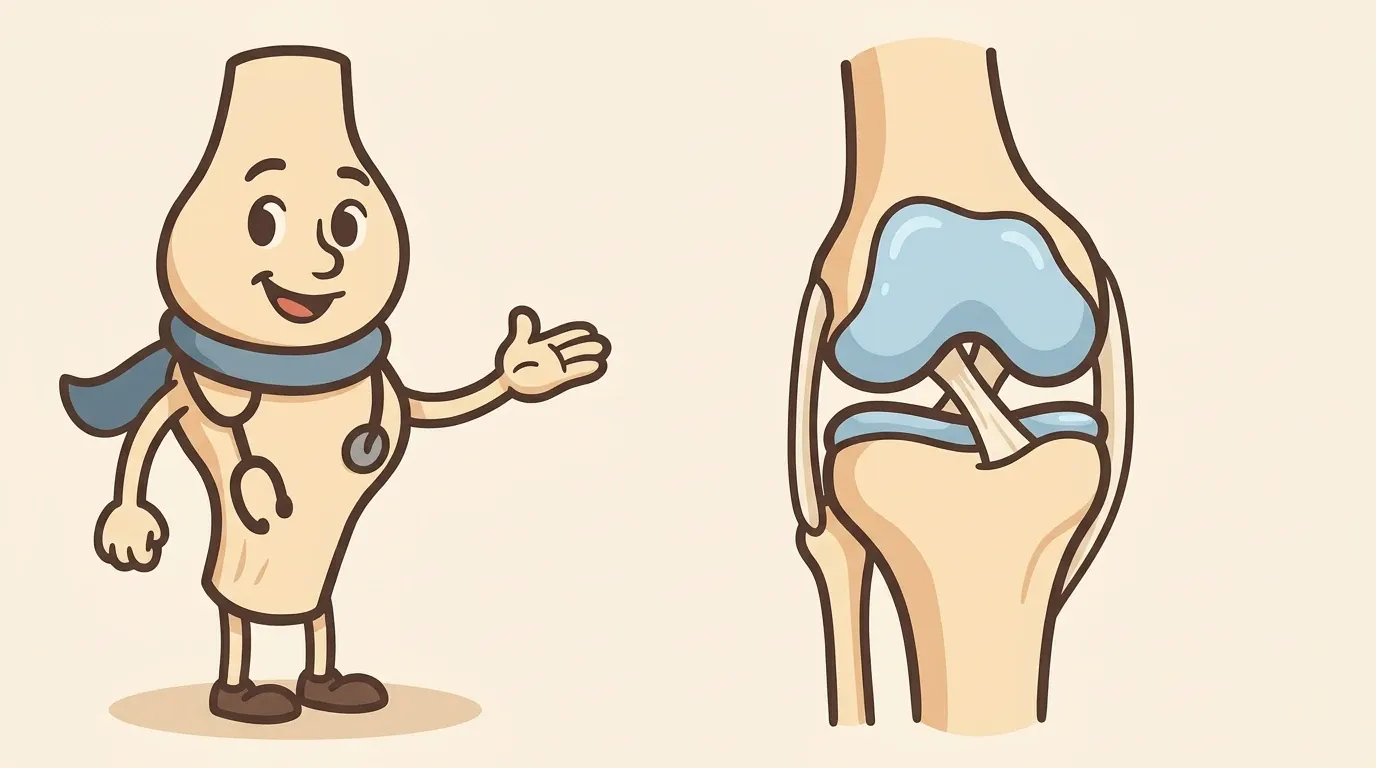
A joint is any place in your body where two or more bones meet. Some joints barely move at all, like the seams in your skull. Others, like your shoulders, hips, knees and fingers, are built to move a lot.
The main parts of a moving joint
Most of the joints you use to bend and reach have the same basic team:
- Bones give the joint its shape and structure.
- Cartilage is a smooth, slippery layer that covers the ends of the bones so they can glide past each other.
- Synovial fluid is a thin fluid inside the joint that helps keep things moving smoothly.
- The joint capsule is a tough covering that wraps around the joint and holds the fluid in.
- Ligaments are strong bands that connect bone to bone and help keep the joint steady.
- Muscles and tendons do the pulling. Tendons connect muscles to bones, so when a muscle tightens, the joint moves.
Different joints, different moves
Joints come in different shapes, and the shape decides how they move:
- Hinge joints, like your elbows and knees, mostly bend and straighten, a bit like a door.
- Ball-and-socket joints, like your hips and shoulders, can move in many directions.
- Pivot joints, like the one near the top of your neck, let you turn side to side.
Why it matters
Knowing the basic parts of a joint makes it easier to understand general health information and to have clearer conversations with a health professional if you ever have questions about your own joints.